Almost everyone asking this question has lost weight before. That is the part that gets left out of the usual answers. The problem is rarely how fast weight comes off, because crash diets are genuinely fast. The problem is that the fast version comes back, which means the timeline that matters is not how long to lose it but how long to lose it and keep it.
Here is the version with numbers attached. A systematic review pooling 80 randomised trials with at least a year of follow-up found a mean loss of 5 to 8.5 kg, roughly 5% to 9% of body weight, over the first 6 months of a reduced-energy diet, with weight plateauing at around the 6 month mark [1]. Rate matters as much as total: in athletes losing weight alongside four strength sessions a week, a target of 0.7% of body weight a week left lean mass 2.1% higher at the end, while a faster target left it unchanged [2]. Those are group averages from trials rather than a forecast for any one person, and individual results vary widely. A structured approach moves through five phases, and each one has a duration you can plan around.
The short answer, in months
The first 1 to 2 months change your habits, not your body. Expect noticeable change in how you feel and modest change on the scale. Around month 3, once eating patterns are genuinely different rather than temporarily suppressed, the change starts being visible to other people. The trial evidence adds a detail most plans leave out: in pooled data the loss does not keep accelerating, it flattens at about 6 months [1]. So the back half of the timeline is not more loss, it is holding what came off. Reaching a weight you can hold onto, and knowing how to hold it, takes roughly 12 to 18 months across the five phases. The scale also moves unevenly week to week for reasons that have nothing to do with fat: water, salt, sleep, where you are in the month. Judging progress weekly is the fastest way to conclude a working plan is broken.
| When | What the trials measured | What it means for you |
|---|---|---|
| Month 6 | Mean loss of 5 to 8.5 kg, about 5% to 9% of body weight, then a plateau [1] | Most of the first drop has already happened |
| Week 8 | Losing 0.7% of body weight a week, lean mass rose 2.1%; in the faster group it did not change [2] | Slower loss spares more lean mass |
| Year 4 | 3 to 6 kg, about 3% to 6%, still held, with no group back at baseline [1] | Partial regain is normal; total regain is not inevitable |
| Year 2 to 5 | Maintainers who hold a loss this long have markedly better odds of holding it longer [3] | Maintenance is the finish line, not the scale |
Months 1 to 2: awareness before restriction
Phase 1, Foundations of Healthy Eating, runs about 1 to 2 months and deliberately changes very little at first. The work is a daily food diary, learning what macronutrients actually do, measuring serving sizes so portion size becomes something you know rather than guess, getting water intake up, and swapping one snack a day for fruit or vegetables.
Most people find this phase anticlimactic, because it feels like preparation rather than progress. It is doing something specific, though. You cannot change a pattern you have never actually looked at, and most failed attempts fail because they jumped straight to restriction without finding out where the calories were coming from. Energy and mood usually improve in this window before the scale does much. By week 4 most people can name their two or three real problem points without anyone having to tell them, and that is the whole output of the phase.

Months 2 to 5: the meal plan starts doing the work
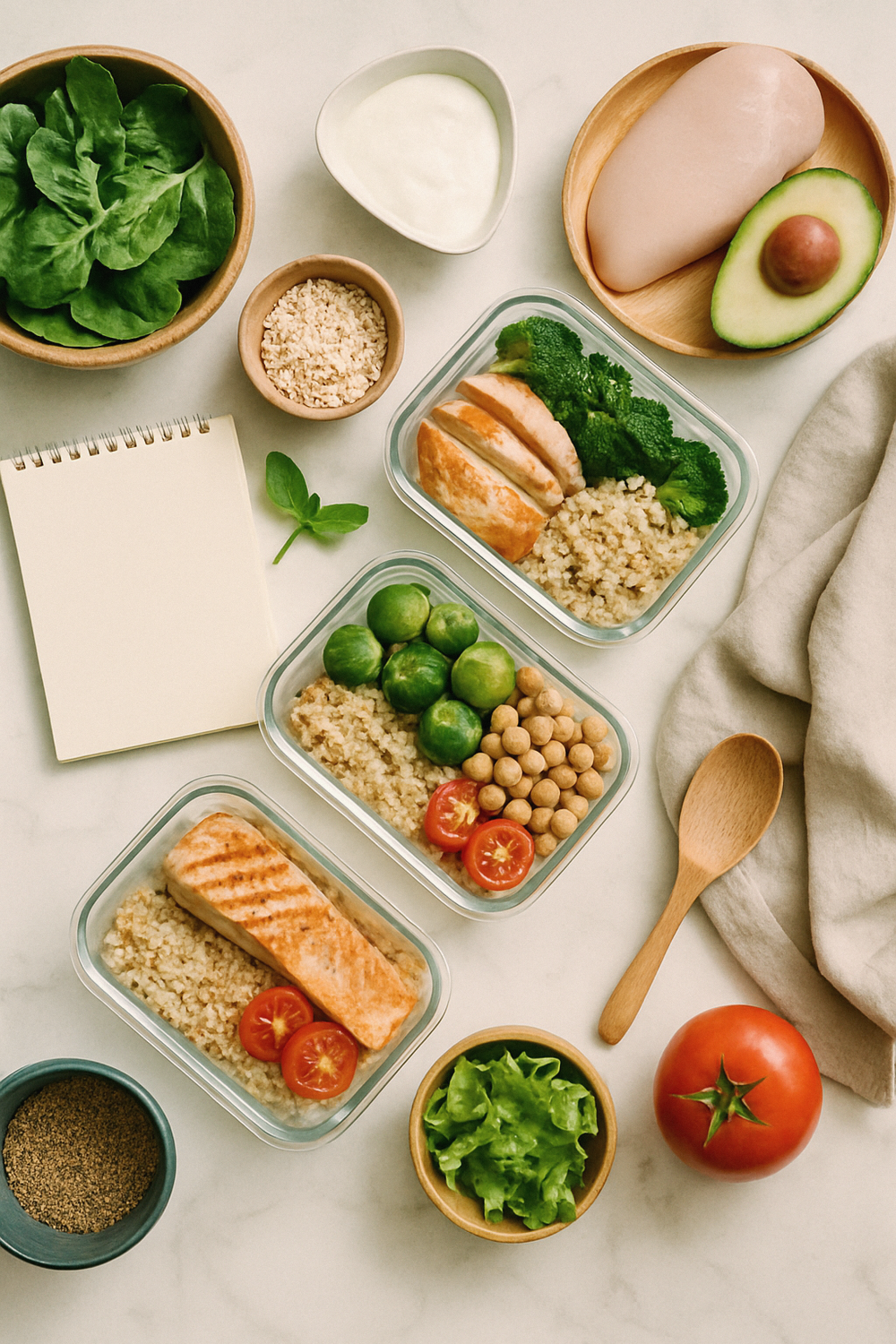
Phase 2, Building a Balanced Meal Plan, runs about 2 to 3 months. This is where a weekly plan covering all the food groups replaces daily improvisation, where you cook a few new recipes so healthy eating is not the same three meals forever, where you find genuinely acceptable alternatives to the high-calorie foods you like, and where batch cooking removes the six o'clock decision that ruins otherwise good days. Reading labels becomes routine rather than a project. This is also the window the pooled trial data is describing when it reports most of the loss arriving before month 6 [1], which is worth knowing in advance: the phase that feels least dramatic is doing most of the measurable work. The reason it works at this point and did not work in previous attempts is not that the food is better. It is that the decision has been moved from the moment you are hungry to a moment when you are not.
Weight loss that arrives before your habits have changed is borrowed. The scale moves first and the pattern snaps back later, which is why the slow phases are the ones that decide whether any of it lasts.
The rest of year 1: movement enters, and the pace steadies
Wellbody builds the system for you.
3 daily actions across fitness, nutrition, mobility, recovery, and mindfulness.


Phase 3, Incorporating Physical Activity, spans about 3 to 6 months. The target is around 150 minutes of moderate exercise a week plus strength training twice a week, and the emphasis is on finding a form of movement you will actually keep doing. Adding exercise to eating habits that are already stable works; adding both at once is how people end up doing neither by February. This is also the point where the research and the phase order genuinely disagree, and it is worth naming rather than smoothing over. The trials in the pooled review ran diet and exercise together from the start, and it was that combination, not diet alone, that the authors tied to moderate loss at 6 months, while exercise alone produced minimal loss at any timepoint [1]. Sequencing movement into month 5 is a judgement about what people can sustain, not a finding the evidence supports. Registry data on people who actually keep weight off is blunter still: they report around an hour a day of physical activity, well above 150 minutes a week [3]. Treat the phase 3 target as a floor for getting started rather than the level associated with holding a loss for years.

Year 2: the part almost every plan skips
Phase 4, Advanced Nutrition Strategies, runs about 3 to 6 months and handles real life: meal prep for weeks that go sideways, mindful eating so meals are satisfying rather than merely counted, and a workable approach to restaurants and other people's houses. Phase 5, Maintenance and Lifestyle Integration, takes another 3 to 6 months and is the phase most diets do not have at all. It builds a long-term plan that includes occasional indulgences on purpose, sets new goals so there is something to aim at after the weight goal is met, and addresses stress and emotional eating directly. This is where the timeline stops looking arbitrary. Roughly 20% of people who lose weight keep at least a tenth of their starting body weight off for a year or more, and the odds of continued success rise markedly once a loss has been held for 2 to 5 years [3]. The last phases are not padding; they are what the long-term data is actually about.
Why the longer timeline is usually the faster one
Add up the attempts. A six-week plan followed by regain, tried three times, is more than a year spent arriving back where you started. The longer version is slower per month and much faster overall, because it only has to work once. The pooled data is reassuring on the point people worry about most: at 4 years participants were still holding 3 to 6 kg, and no intervention group had drifted all the way back to baseline [1]. It also depends on things that are not food: 7 to 8 hours of sleep, and rest days that stop the whole thing collapsing into burnout. Wellbody runs this as three daily actions spanning nutrition, movement, mindset and recovery, so the supporting pieces happen on the same schedule as the eating. Two caveats before planning around any of these numbers: the rate study used 24 elite athletes already doing four resistance sessions a week [2], which is not most people, and the pooled figures are averages across 80 trials with wide spread inside them [1].
Sources
- [1]Franz MJ, VanWormer JJ, Crain AL, et al. (2007). Weight-loss outcomes: a systematic review and meta-analysis of weight-loss clinical trials with a minimum 1-year follow-up. Journal of the American Dietetic Association 107(10): 1755-1767.
- [2]Garthe I, Raastad T, Refsnes PE, Koivisto A, Sundgot-Borgen J (2011). Effect of two different weight-loss rates on body composition and strength and power-related performance in elite athletes. International Journal of Sport Nutrition and Exercise Metabolism 21(2): 97-104.
- [3]Wing RR, Phelan S (2005). Long-term weight loss maintenance. American Journal of Clinical Nutrition 82(1 Suppl): 222S-225S.
About Wellbody
Wellbody is a body health app that replaces the stack. Pick one goal and it builds three daily actions across fitness, nutrition, mobility, recovery and mindfulness, then adjusts them around what you actually did. Connected behind the scenes so you don't have to manage the pieces, and it grows with you: month six looks nothing like month one. No dashboards, no re-planning. You just keep showing up.